
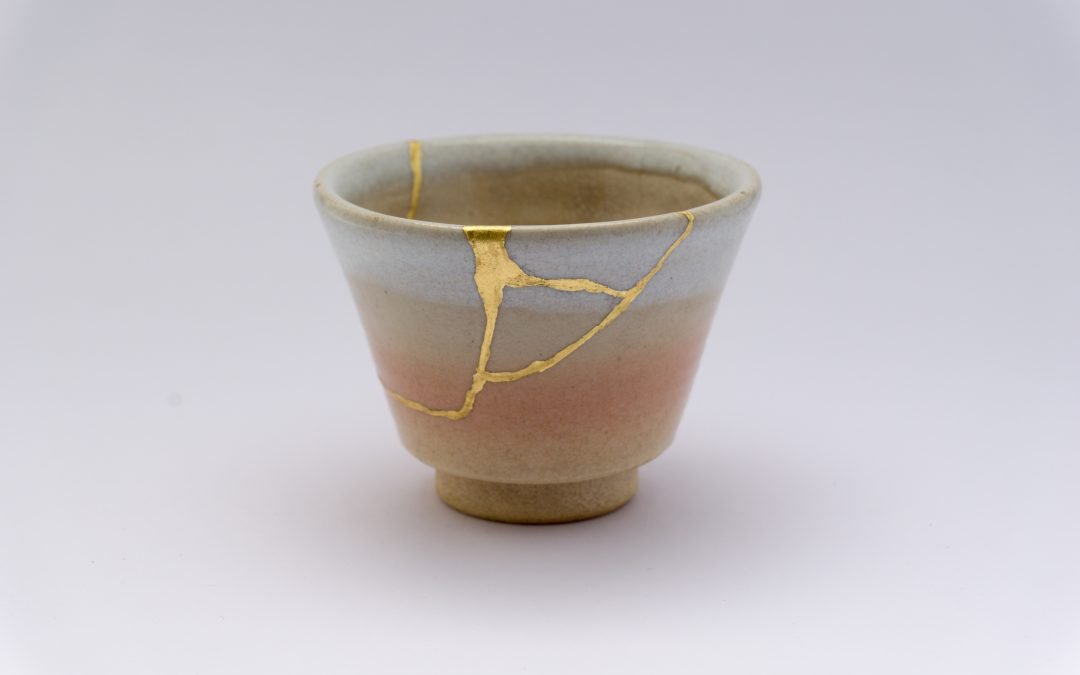
We all have events in our history that we can’t change. Successful healing journeys integrate these events into our lives in ways that honor our lived experiences, and ultimately lift us up.
A wound, once inflicted, cannot be undone. Like Japanese kintsugi, the best we can hope for is a gentle reminder of the transience of our physical form and the beauty in our broken places.
It’s been 8 months since I caught my foot on the bottom step of my neighbor’s porch. It was like tripping on a stationary escalator—what my brain expected was different than what my body was experiencing. The walking momentum of my upper body continued unimpeded, while the sudden resistance at foot level threw me forward with very little time to control the outcome.
In the milliseconds before the wine bottle in my left hand could shatter on the stoop and cut me to ribbons, I managed to give it a quarter turn to the left, orienting it horizontally. I avoided smashing it under my hand, but my wrist, which was turned forward as I tried to catch myself, was laid open by the sharp edge of a slate step.
My immediate response (alternately yelling “oh, FUCK!” and “GET A TOWEL!”) was accompanied by a string of unkind internal voices: “Now you’ve ruined everything. Tripping UP the steps, WHO DOES THAT? Are we going to bleed out on the stoop??”
A cacophony of blame-y “should’s” followed behind—We should have stayed home! I should have been more careful! They should have better light out here!
Eventually, my mindfulness training kicked in—I slowed and deepened my breath to calm my nervous system, reminded myself that this level of injury could be fixed (it’s-amazing-what-doctors-can-do-these-days!), and that with a clean towel and some pressure, I’d be good for the trip to the ER.
….
We’d been invited for a quick bon voyage toast with our neighbors down the lane before we left for a long-anticipated week of snowboarding in New Hampshire. Our lift tickets were pre-purchased. Provisions were boxed up and loaded into the car with the luggage. Two snowboards were strapped to the roof racks. Two other couples planned to meet us at the condo.
Instead of leaving early Saturday morning, we spent Friday evening in the ER.
I didn’t know the extent of the damage until I got to a surgeon on Tuesday—two tendons and the median nerve (ugh, Google it) were severed. It promised to be a long recovery, and 8 months later, the fallout from the accident is still very much present.
And, according to my hand surgeon, it probably always will be.
Along with a maddening combination of numbness and textural sensitivity in my thumb (which makes cat fur feel like sandpaper), there’s muscular weakness, and an ongoing battle to keep scar tissue from hardening.
While woefully unpleasant, the injury has taught me three major lessons (so far).
The first is how to differentiate sensation, discomfort, and pain—a useful distinction in both physical and metaphorical realms.
There were moments when my hand “fizzed”—a buzzing sensation, like bees living in my nerve endings—not pleasant or unpleasant, just a sensation that wasn’t there before. Discomfort presented as a stabbing ice pick that made my entire body contract reflexively —YEOW!—or as an ache that was attention-grabbing and unpleasant, yet tolerable and short-lived.
The only time my brain registered “pain!” was when discomfort was accompanied by fear or self-pity.
I got curious about pain. What was I afraid of?
When I worried that I’d re-injured it, or that the discomfort would never stop, it HURT. When I believed I couldn’t tolerate it and medication was useless, I dove headfirst into the pity pool, and ugly-cried until the feeling passed.
When I extend those terms to my emotional state, I notice how fear intensifies difficult emotions.
The second lesson is acceptance. I can’t force myself to accept that clocks only run backward in works of fiction (where it reliably turns out badly), but I can recognize the despair of wanting to turn back the clock. I want to un-do something, anything, to prevent what has already happened. I repeatedly ask myself why: why didn’t I put the bottle in a bag rather than carry it by the neck? Say “no” to the invitation? Pay attention to my feet in the winter dusk?
If “why” sounds like self-blame, that’s because it is. I wish I could claim that the regret has disappeared completely—it hasn’t. But it has receded into a barely perceptible shadow of longing—for life as it was in the “before” column.
Lesson three: I will never not have this wound. I am learning to accommodate its existence all day, every day. It won’t heal completely—my hand will never have the strength, dexterity, and sensitivity it had in the moment before I fell—but it will heal enough.
It already has.
